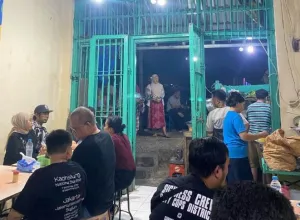
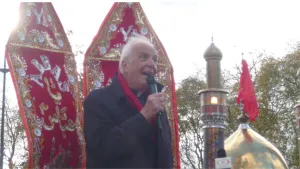
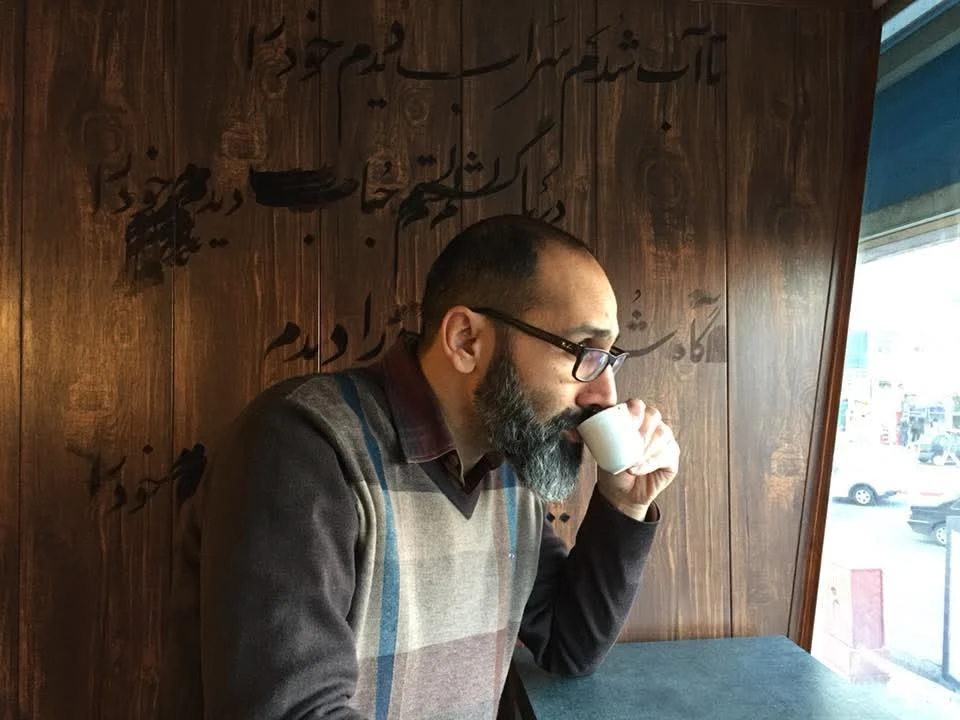
 The spirit of isār takes form—where self-sacrifice becomes not just thought, but a lived collective consciousness. (Photo credit: Assoc. Prof. Dr. Ahmet Yeşil).
By Assoc.Prof. Dr. Ahmet Yeşil*
In the recent conflict between Iran and USA-Israel, the visible presence of Iranian leaders on the ground and the people’s refusal to leave the streets for nearly a month while supporting the government serve as a significant example for understanding how Iranian society embodies its collective behavior as well as its understanding of self-sacrifice and self-denial during times of crisis, a process that can be interpreted as a contemporary manifestation of self-sacrifice that in Iranian society has evolved not merely into an individual virtue but into a way of life, where the people’s collective movement is not merely a political reflex but a behavioral pattern rooted in deep historical, cultural, and social foundations that may be difficult for those unfamiliar with this culture to understand and interpret.
In Iran, when external threats arise, the people taking to the streets to stand with the government, uniting as a society, commanders being intertwined with the people (as my father would say, this society loves such leaders and embraces them), family members not hiding in shelters, and sharing the risk and its cost are all forms of behavior shaped by the social codes in which individuals are raised, which in turn shape individual actions and become part of the collective consciousness through social norms, making individual self-sacrifice a natural reflection of shared community values.
At the heart of all this behavior lies isār (ایثار), or self-sacrifice, which literally means a person sacrificing their own rights, interests, or opportunities for the sake of another and prioritizing others over themselves, yet in the Iranian context goes beyond an individual virtue to become the cornerstone of social identity and collective behavior, a phenomenon that cannot be fully explained within the framework of rationality or reason because theoretical and logical analyses fall short of capturing its deep historical, cultural, and social context, as for these people isār is a reality ingrained in their very souls and has become both an individual virtue and a shared social norm continuously reinforced through historical experiences, cultural rituals, and daily life practices.
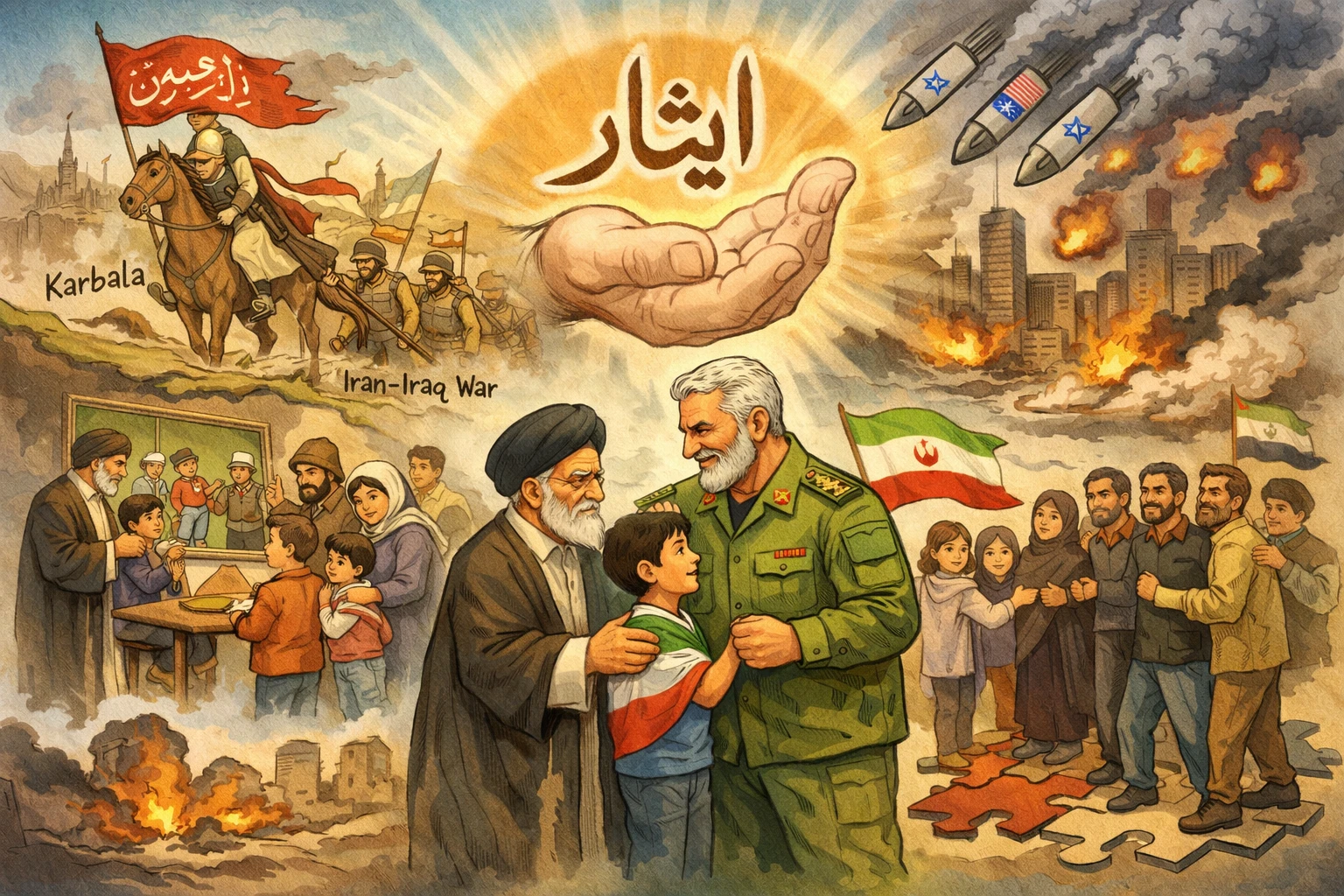
Where leaders embody sacrifice, a shared consciousness rises—transforming personal devotion into collective strength. (The caricature was created by AI).
The roots of the spirit of self-sacrifice lie in a deep historical and religious heritage, where the Battle of Karbala and the stance of Imam Hussein (as) have become embedded in the collective memory of society as the supreme example of self-sacrifice, and the belief that everything can be sacrificed for justice regardless of numerical strength has been transmitted across generations through narratives, rituals, and mourning ceremonies, transforming self-sacrifice from an abstract moral value into a living behavioral model in Iran.
In the modern era, this narrative was further reinforced through the concrete experience of the Iran-Iraq War, during which public participation at the front and widespread social solidarity ensured that self-sacrifice became a value practiced in everyday life, no longer merely a historical example from Karbala but a living and ongoing social practice.
This value is also continuously reproduced through education from early childhood, as it is instilled in children through stories such as that of the self-sacrificing villager taught in elementary school and reinforced throughout their educational journey with various narratives that shape their mindset, making the consciousness of self-sacrifice a natural and inseparable part of life.
Social bonds and shared values facilitate unity during times of crisis, as individuals act with a collective consciousness nourished by historical experiences and cultural habits that elevate self-sacrifice beyond an individual virtue into a shared and internalized social norm, constantly reinforced through family, education, and leader-public interaction, thereby enabling social solidarity in critical moments.
The spirit of unity and solidarity in Iranian society during times of danger, reflected in the joint action of commanders and the people, is a natural outcome of the deeply rooted consciousness of self-sacrifice shaped by the experiences of Karbala and the Iran-Iraq War and continuously reinforced through education, becoming a way of life that is deeply ingrained in the very souls of the people.**
*The author is a Faculty Member at the Faculty of Theology, Sakarya University, Turkey
**This article is derived from a publication on on4haber.com, dated April 3, 2026, entitled “Kolektif Bilinç ve Îsâr: İran’da Lider-Halk Etkileşimi ve Fedakârlık,” and was translated by its author, Assoc. Prof.DrProf. Dr. Ahmet Yeşil.