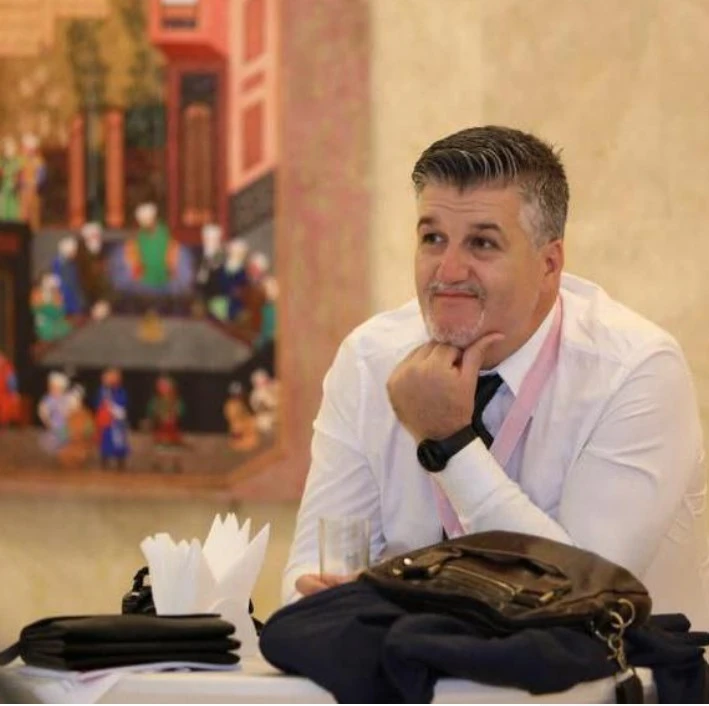
 Ermal Bega, orientalist and cultural researcher, serves as the Executive Director of the Albanian Center for Oriental Studies in Tirana, where he dedicates his work to exploring the historical and cultural connections between Albanian society and the broader Islamic and Eastern intellectual traditions.
Words by Ermal Bega*
Ramadan in Albania has always been more than a ritual observance of fasting; it is a social season in which faith, history, and national culture converge to reaffirm the spiritual identity of a society that has long lived at the crossroads of civilizations.
Beginning on February 19, 2026, Muslims across Albania and other Albanian-populated regions—such as Kosovo, parts of Montenegro, North Macedonia, and northern Greece—commenced the fast of the blessed month of Ramadan according to the Islamic lunar calendar, joining more than 1.9 billion Muslims worldwide who observe the same sacred tradition.
Throughout this period, which continues until March 19, 2026, with the celebration of Eid al-Fitr expected on March 20, Albanian Muslims dedicate themselves to fasting, prayer, charity, and spiritual reflection in obedience to the divine command prescribed in the Qur’an for the believers.
In Albania itself, the atmosphere of Ramadan is not confined solely to religious observance, but also manifests as a social and cultural phenomenon that reveals the remarkable coexistence among communities that have historically shaped the country’s identity.
The Republic of Albania, situated in Southeastern Europe on the western edge of the Balkan Peninsula along the Adriatic and Ionian Seas, occupies a strategic geographical position between Western Europe and the Eastern Mediterranean world, bordering Montenegro to the northwest, Kosovo to the northeast, North Macedonia to the east, and Greece to the south.
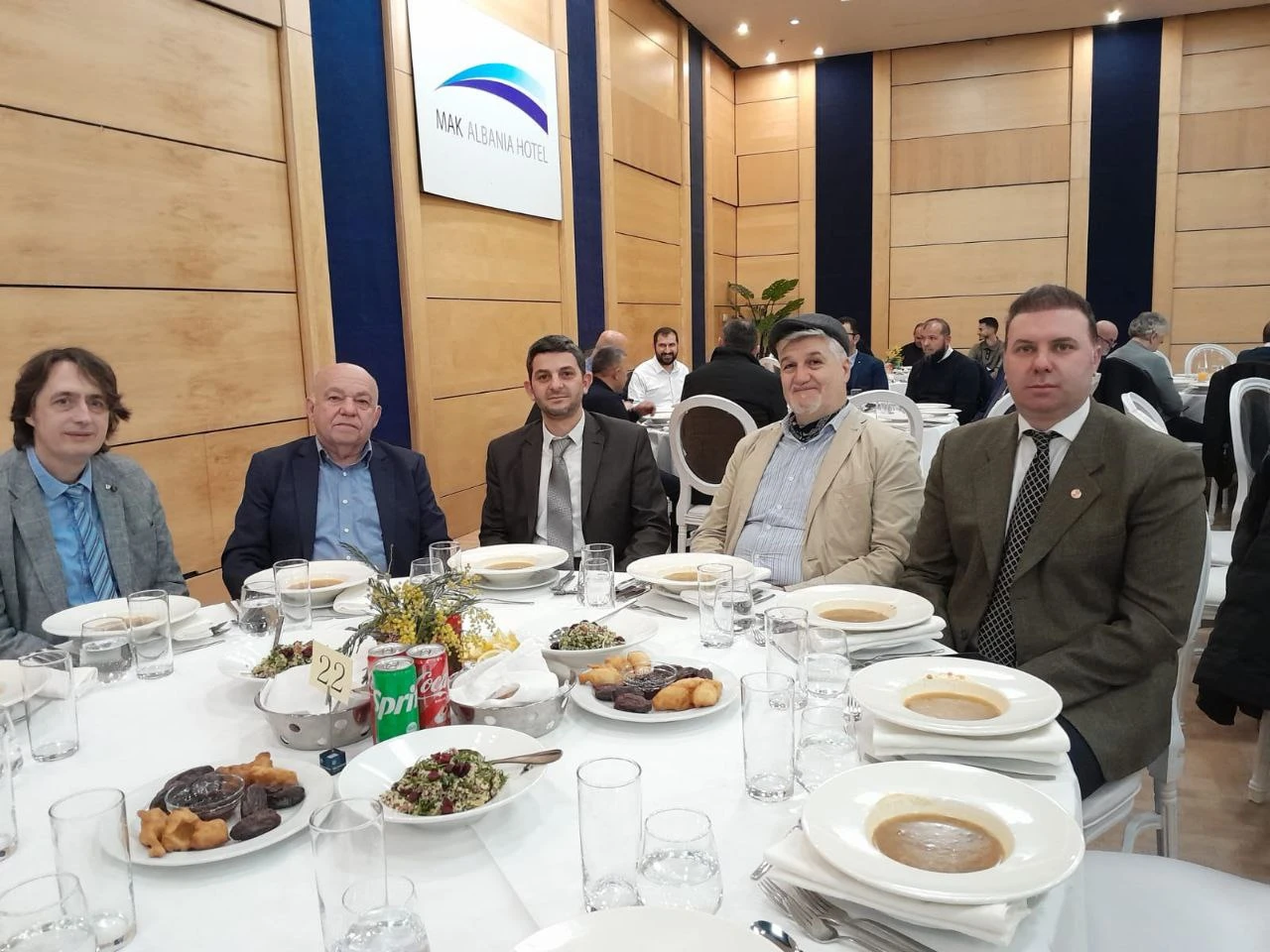
One of the iftars being offered in Tirana, Ramadan 2026
This geographical location has historically made Albania a meeting point of cultures, religions, and political systems, a reality that continues to influence its modern identity as a parliamentary republic governed by a democratic constitution adopted after the collapse of communism in the early 1990s.
Today Albania functions as a parliamentary constitutional republic in which executive authority is exercised by a government led by a prime minister, while legislative authority rests with a unicameral parliament known as the Kuvendi, reflecting the country’s transition toward democratic governance and integration with European institutions.
The national language of Albania is Albanian (Shqip), a unique Indo-European language forming its own independent branch within the Indo-European family, which has served as a key cultural pillar in preserving national identity throughout centuries of foreign rule and political transformation.
Within this historical and linguistic framework, Islam occupies a central place in Albania’s religious landscape, as approximately 55 to 60 percent of the country’s population identifies culturally or religiously with Islam, making it the largest religious community in the nation.
According to demographic estimates derived from national surveys and international research institutions such as the Pew Research Center, Albania’s Muslim population numbers roughly 1.7 million people out of a total population of about 2.8 million.
The roots of Islam in Albania stretch back to the late fourteenth and fifteenth centuries when the region gradually came under the rule of the Ottoman Empire, whose administrative, educational, and spiritual institutions introduced Islamic traditions to the Balkans.
During the centuries of Ottoman presence, Islam spread not only through political structures but also through the work of scholars, Sufi orders, and local cultural adaptation, which allowed the religion to develop organically within Albanian society.
Among the most influential spiritual traditions in Albania were the Bektashi Sufi order and other mystical brotherhoods that blended Islamic spirituality with local cultural sensibilities, producing a distinctive form of Balkan Islam known for its tolerance and openness.
Despite the suppression of religion during Albania’s communist era—when the regime of Enver Hoxha declared the country the world’s first officially atheist state in 1967—religious identity survived within families and communities until it re-emerged publicly after the fall of communism in 1991.
Since the restoration of religious freedom in the early 1990s, Islam in Albania has experienced a gradual revival marked by the reopening of mosques, the reestablishment of religious education, and renewed public participation in Islamic practices such as Ramadan fasting.
This revival is particularly visible during Ramadan, when mosques throughout the country—from the historic Et'hem Bey Mosque in Tirana to smaller neighborhood mosques—become centers of prayer, charity, and communal gatherings.
During the holy month of Ramadan in 2026, Albanian Muslims once again joined the global Islamic community in observing the fast with devotion, humility, and gratitude toward Allah the Almighty.
In Tirana, the capital city, the rhythm of Ramadan becomes especially visible as restaurants prepare evening meals for iftar, mosques fill with worshippers for the night prayers, and families gather after sunset to break their fast together.
One of the most striking aspects of Ramadan in Albania is the growing number of communal iftars organized by local communities, charitable organizations, and cultural associations that bring together people from various social and religious backgrounds.
Such gatherings illustrate the enduring spirit of Albanian coexistence, where Muslims, Catholics, Orthodox Christians, and secular citizens often share public space and social traditions in mutual respect.
In fact, during the Ramadan of 2026 it has not been uncommon to witness Albanian Christians joining Muslim friends and neighbors in fasting or attending communal iftars, demonstrating a form of social solidarity that has become characteristic of Albanian society.
This phenomenon reflects a broader cultural principle deeply embedded in Albanian history: the idea that religious identity should coexist with national unity rather than divide it.
Following the evening meal of iftar, many Muslims proceed to local mosques to perform the nightly Taraweeh prayers, which are conducted throughout the month as a communal act of devotion.
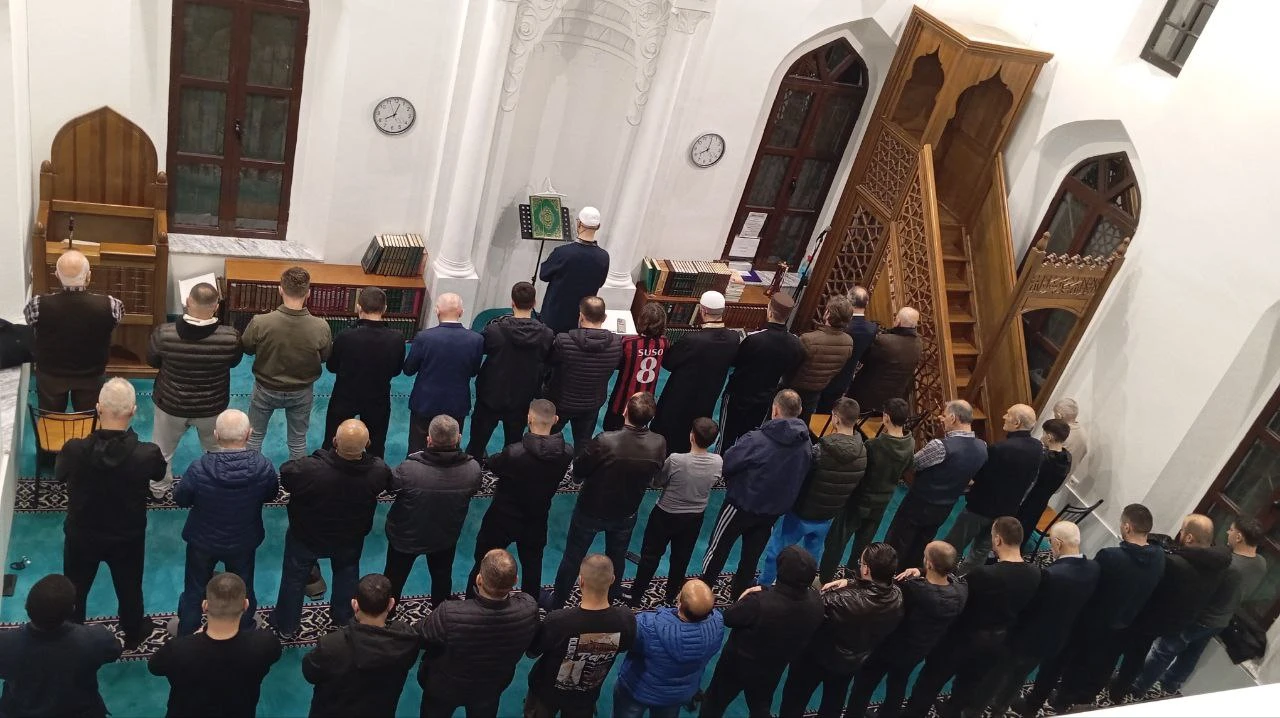
Praying of taraweeh in the Bazaar Mosque (Kokonozi Mosque) in Tirana
One notable location where such prayers take place is the historic Kokonozi Mosque, also known as the Bazaar Mosque in Tirana, where worshippers gather nightly in an atmosphere of reverence and spiritual reflection.
After completing the prayers, many believers continue their social interactions in cafés and tea houses, where conversations extend late into the night, reflecting both the religious and communal dimensions of Ramadan life.
As the holy month approaches its final phase, the last ten nights of Ramadan hold particular significance for Albanian Muslims, as believers seek the blessed Night of Power, Laylat al-Qadr, which according to Islamic tradition is better than a thousand months of worship.
During these nights, mosques across Albania remain open until the early hours of the morning as men and women gather for additional prayers, Qur’anic recitation, and personal supplications.
In these quiet moments of midnight devotion, Albanian worshippers pray not only for their own families but also for the well-being of their society and the broader Muslim world.
Particular prayers are offered for communities suffering from war, oppression, or humanitarian crises, reminding worshippers that the spiritual dimension of Ramadan is inseparable from compassion for humanity.
Thus, Ramadan in Albania in 2026 stands as both a continuation of centuries-old traditions and a contemporary expression of faith shaped by a modern democratic society.
It is a month in which Albania’s historical memory, religious identity, and culture of coexistence converge in a living testimony that faith, when practiced with sincerity and humility, can strengthen both spiritual life and social harmony.
*Author, Orientalist and Cultural Researcher Executive Director of the Albanian Center for Oriental Studies, Tirana, Albania