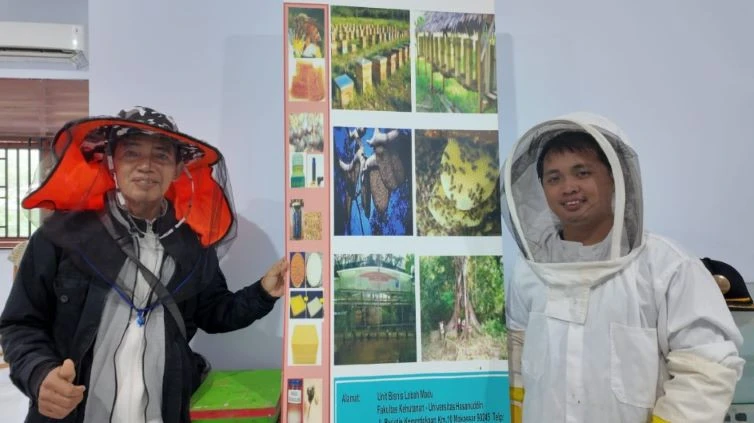
MAKASSAR, UNHAS.TV - The Faculty of Forestry (Fahutan) at Hasanuddin University (Unhas) has hundreds of bee colonies. These colonies are housed in hives spread across three locations: the Awani Bee Garden (Kebun Lebah Awani), the Maros Educational Forest, and the Fahutan Jungle Forest.
These bee colonies consist of various species taken from various regions in Indonesia, such as Sulawesi, Java, Kalimantan, Sumatra, and Papua.
Lecturer and bee researcher at Unhas, Prof. Dr. Ir. Budiaman MP, stated that one of the bee species being developed is the stingless bee, or kelulut.
"The kelulut bees, or stingless bees, that are bred are of various species, such as Tetragonula biroi, Tetragonula fuscobalteata, Tetragonula sapiens, and Tetragonula laeviceps," Budiaman explained during an interview at the Jungle Forest on Saturday (12/13/2025).
In addition to the stingless bee, Hasanuddin University also breeds the Asian bee (Apis cerana) and the European bee (Apis mellifera), which are superior bee species and are widely cultivated commercially.
To support the survival of endemic bees in Sulawesi, Budiaman stated that efforts are underway to breed the wild bee Apis dorsata binghami, a large species that has previously been considered unsuitable for cultivation.
"The bee species we cultivate most at Hasanuddin University are the local species, Tetragonula biroi, as well as the Apis cerana and Apis mellifera bees. These three species are our mainstays," he said.
The 1967-born man has produced various products from his beekeeping activities. These products include honey, bee bread, royal jelly, soap, aromatherapy candles, and shampoo. Budiaman even once ran an alternative medicine clinic using bee sting treatments.
He said the biggest challenge in managing a bee farm lies in the availability and continuity of food. There are certain periods when food supply is interrupted.
"Every plant has a different flowering period. Some plants have short, medium, or relatively long flowering periods," he explained.
Bee food comes from natural sources such as flowers or sweet fluids released from other plant parts, such as fruit sap, leaf sap, or the results of interactions with certain insects.
In addition to nectar, bees also greatly require pollen, the appearance of which varies from plant to plant. "Therefore, each plant has a different flowering rhythm and food availability," Budiaman explained.
During his visit to the bee farm, Budiaman also showed the beekeepers' clothing when inspecting or harvesting honey. These spacesuit-like suits protect them from bee stings.
"Bees are actually harmless; they only sting when disturbed," he said while donning a hat and protective clothing.
Budiaman revealed that he began managing beekeeping when he was writing his thesis in 1989. These bees, which possess numerous benefits, have led Budiaman to travel throughout Indonesia, introducing, mentoring, and establishing organizations and companies engaged in honeybee cultivation. He was even asked to mentor beekeepers in Malaysia. (*)
Achmad Ghiffary M (Unhas TV)


-300x204.webp)


-300x201.webp)